
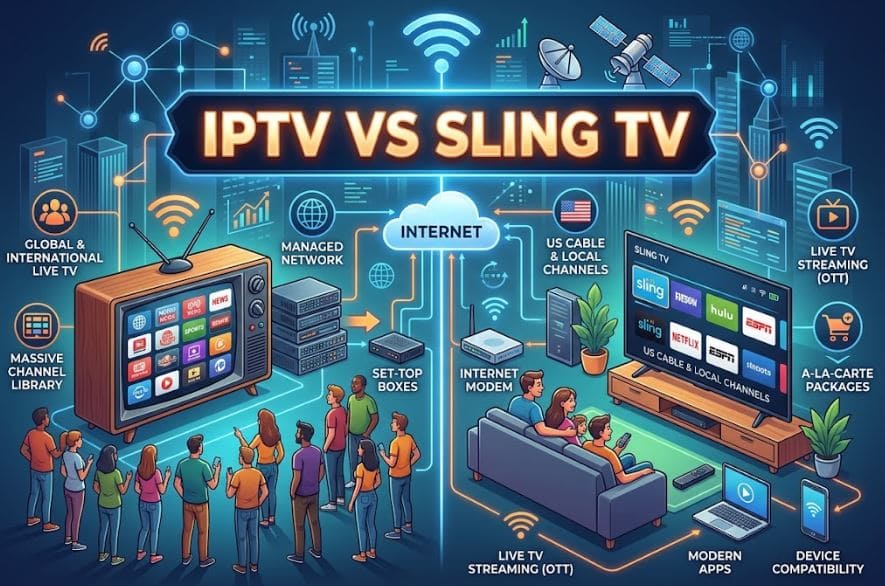
The golden age of cable is officially over. Everyone is cuting the cord. IPTV VS Sling TV with their comparison chart details you’ll get here leaving traditional TV doesn’t mean you have to give up your favorite live sports, news, or primetime shows. The biggest dilemma facing modern viewers today is no longer “should I cut the cord?” but “which service should I replace it with?”
Two of the most dominant forces in the modern television landscape are IPTV VS Sling TV. While both deliver TV over the internet, they operate on vastly different models, offer divergent content libraries, and come with unique legal and technical considerations.
If you are struggling to understand the difference between IPTV and Sling TV, you are not alone. This optimized guide will dissect everything you need to know, from pricing and legality to channel lineups and device compatibility. You’ll know exactly which is better: IPTV or Sling TV for your household.
What is the Difference Between IPTV and Sling TV?
To understand the core conflict, we need a clear definition of both technologies. At their heart, both are forms of Internet Protocol Television—they use the internet to transmit TV signals rather than old-fashioned coaxial cables or satellite dishes.
However, in the consumer marketplace, the terms have taken on very distinct meanings.
What is IPTV?
Broadly speaking, IPTV (Internet Protocol Television) is the umbrella term for any television content delivered over the internet. Technically, Zest IPTV, YouTube TV, Pixzo TV and Sling TV are all forms of IPTV.
However, when people search for “IPTV” or sign up for “IPTV services,” they are usually referring to managed-network or third-party IPTV providers. These services often provide thousands of live international channels, huge on-demand movie libraries, and PPV fights events, frequently at an unbelievably low price.
Managed IPTV is often delivered through a specific set-top box provided by a telecommunications company (like your ISP’s TV offering) or through a customizable app on a streaming stick where you must input a playlist from a provider.
What is Sling TV?
Sling TV is a specific, brand-name consumer service owned by DISH Network. It is classified as a vMVPD (virtual Multichannel Video Programming Distributor).
Unlike a generic IPTV provider that might sell you a “playlist” of 10,000 channels, Sling TV is a polished, legal, and highly structured streaming platform. Its primary goal is “skinny bundling”—giving you a smaller, customizable selection of the most popular American cable channels (like ESPN, CNN, HGTV, TNT) for a much lower price than a standard cable package.
Key Differences Breakdown: IPTV VS Sling TV
The easiest way to view the difference between IPTV and Sling TV is through their operating philosophy, scale, and legal standing.
| Feature | Managed/Third-Party IPTV | Sling TV |
| Provider Type | ISP, Telco, or Third-Party Provider | DISH Network Corporation |
| Legal Status | Highly Variable. Many cheap providers are unlicensed (pirate services). Some are legal ISP offerings. | 100% Legal and Licensed. |
| Channel Count | 1,000 to 15,000+ (Often Global) | 30 to 50+ (Focus on Top US Cable) |
| Pricing Model | Often very cheap ($5-$20/mo) for thousands of channels. | Structured packages ($40-$55+/mo) + Add-ons. |
| Customization | Low (You get what the provider offers). | High (Choose Orange/Blue base + genre add-ons). |
| Interface | Varies widely by app (e.g., Tivimate, GSE). Often less polished. | Uniform, polished app across all devices. |
| Reliability | Variable. Can suffer from buffering, channel downtime, or shutdowns. | Stable, though subject to standard internet congestion. |
Detailed Analysis: Which Service is Right for You?
Let’s dive deeper into the parameters that actually affect your daily viewing experience.
1. Legality: The Elephant in the Room
This is the absolute first thing you must consider when comparing IPTV or Sling TV.
- Sling TV: There is zero ambiguity here. Sling TV is owned by a massive corporation (DISH), pays licensing fees to every network it broadcasts (like Disney, Turner, AMC), and operates entirely within the law in the United States. When you pay Sling, you are supporting the content creators.
- IPTV: This is a minefield. While the technology of IPTV is 100% legal, thousands of third-party IPTV services are illegal pirate operations. If a service is offering 10,000 channels, PPV events, and movies still in theaters for $10 a month, it is almost certainly unlicensed. Using these services carries risks: your data could be stolen, the service could be shut down overnight by the feds (costing you your subscription money), or you could receive a copyright notice from your ISP.
2. Channel Lineup and Content Quality
- Sling TV: Focuses on quality over quantity. They don’t want to give you 5,000 filler channels. Their two base packages (Sling Orange and Sling Blue) are designed to include “can’t-miss” TV. Sling Orange has Disney/ESPN. Sling Blue has Fox/NBC/USA/Bravo. They cover 90% of what most Americans actually watch.
- IPTV: Focuses on sheer volume. A typical IPTV provider will offer local channels from almost every country on Earth, hundreds of dedicated sports channels (covering every league imaginable), and a massive library of Video on Demand (VOD) content. The quality can vary; some channels will be in crisp 4K, while others might be low-resolution or in the wrong language.
3. Ease of Use and Technical Setup
- Sling TV: Incredibly simple. You create an account on their website, download the “Sling TV” app on your Smart TV, Roku, Firestick, or phone, sign in, and you are watching TV within minutes. The interface is modern, polished, and intuitive.
- IPTV: Usually requires more technical know-how. You often have to buy a specific subscription, received an M3U playlist URL or Xtream Codes login, download a third-party IPTV player app (like Tivimate or Perfect Player) on your device, and configure the app manually to load the playlist.
4. Reliability and Buffering
- Sling TV: Since they have licensed, high-bandwidth dedicated servers, Sling TV is generally very stable. If you have a decent internet connection, you will experience very little buffering.
- IPTV: This is the achilles heel of illegal IPTV. Because they operate in the shadows, their servers are often overloaded, poorly maintained, or being actively attacked/blocked by ISPs. You may encounter frequent buffering, “channel offline” errors, or total service outages during major live sporting events.
Pros and Cons of IPTV and Sling TV
Let’s weigh the good and the bad to see where the balance lies.
Pros and Cons of Sling TV
| Pros | Cons |
| 100% Legal and Secure. | Price has increased over the years ($40/mo base). |
| Polished, easy-to-use interface on all devices. | Channel lineup is restrictive compared to full cable or IPTV. |
| Reliable streaming with minimal buffering. | Local channel access (ABC, CBS, NBC, FOX) is limited by region. |
| Excellent “Skinny Bundling” customization (Orange vs Blue). | You might need to buy both Orange & Blue to get all top channels. |
| Legal Cloud DVR included (usually 50 hours). | Cloud DVR storage is relatively low. |
Pros and Cons of Managed/Third-Party IPTV
| Pros | Cons |
| Incredibly low price for the amount of content. | High risk of illegality (supporting piracy). |
| Massive channel selection (Thousands of international/local). | Frequent stability issues, buffering, and downtime. |
| Access to every sports league and PPV event without extra fees. | Interface is often clunky, technical, or outdated. |
| Enormous VOD library included. | Setup requires technical knowledge and third-party apps. |
| Watch content from your home country anywhere in the world. | Service can vanish without notice, taking your money with it. |
Read also more related topics: Kodi vs IPTV
Difference Between OTT and VOD
Which is Better: IPTV or Sling TV? The Verdict
There is no single “better” option; there is only the better option for you. Your choice depends entirely on your budget, tolerance for technical friction, and your ethical stance on copyright.
Choose Sling TV if:
- You want a simple, legal, and hassle-free experience. You have a family and just want to turn on the TV and have it work.
- Your primary focus is popular American cable channels (ESPN, CNN, Food Network, Disney).
- You are willing to pay a fair price for stable, licensed streams.
- You don’t want to worry about data security or copyright issues.
Choose Managed/Third-Party IPTV if:
- Your budget is extremely tight, and you simply cannot afford $40+/month for TV.
- You are a hardcore international or niche sports fan (e.g., wanting to watch cricket in the US or second-division football from Argentina).
- You are tech-savvy and comfortable setting up apps, managing playlists, and troubleshooting network issues.
- You understand and accept the legality and reliability risks associated with unlicensed services.
In 2026, cord-cutting is about freedom. Sling TV offers the freedom of customization with a premium, legal framework. Managed IPTV offers the freedom of infinite content at a basement-level price, but with significant compromises in legality and quality.