
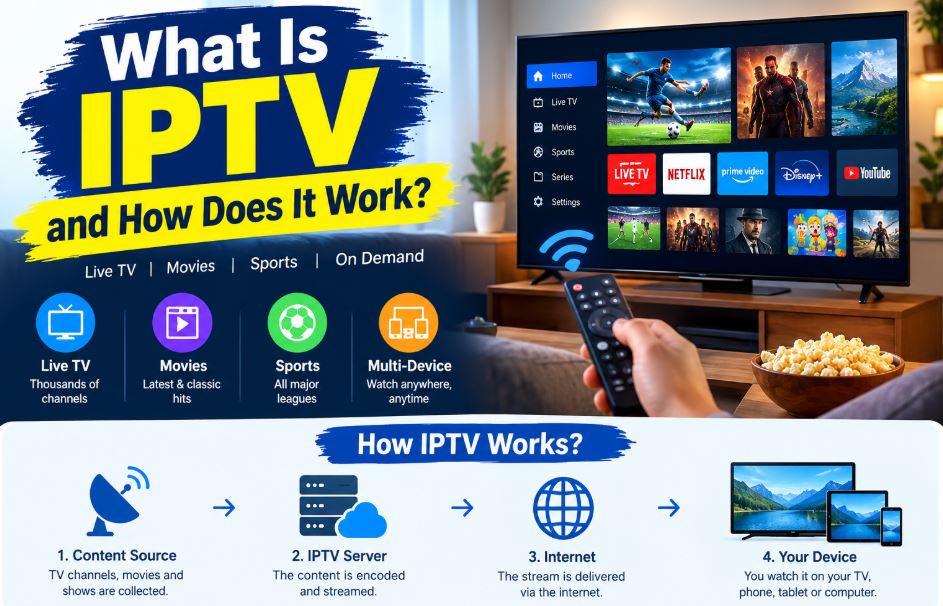
If you have searched for What is IPTV and how does it work?, you are probably looking for a simpler way to understand modern television streaming. IPTV has changed how people access live TV, sports, movies, news, entertainment, and on-demand content through an internet connection.
Unlike traditional cable or satellite television, IPTV uses Internet Protocol (IP) technology to deliver television content. This means your TV programs can travel through an internet or managed IP network and reach devices such as Smart TVs, smartphones, tablets, computers, streaming boxes, and other compatible devices.
But how does IPTV actually work? What equipment do you need? Is IPTV different from Netflix or YouTube? And how does IPTV work in Canada, the USA, and the UK?
What Is IPTV and How Does It Work? Full Guidelines
This complete guide explains everything in simple language.
What Is IPTV?
IPTV stands for Internet Protocol Television. It is a method of delivering television programming through an IP network instead of relying only on traditional terrestrial broadcasting, cable networks, or satellite transmission.
In simple terms, IPTV allows television content to travel through an internet-based or IP network to your viewing device.
When you watch an IPTV channel, the video is delivered as digital data. Your IPTV application, media player, or set-top box receives that data and converts it into video and audio that you can watch on your screen.
IPTV can support different types of content, including:
- Live television channels
- Sports broadcasts
- News channels
- Movies
- TV shows
- Video on demand
- Catch-up television
- Recorded programming
- International channels
- Specialized entertainment channels
The exact content available depends on the IPTV provider, subscription, licensing arrangements, and your location.
What Does IPTV Mean?
The term IPTV combines two important ideas:
- IP means Internet Protocol, the technology used to move digital information across networks.
- TV means television programming.
Therefore, IPTV essentially means television delivered using Internet Protocol technology.
However, IPTV should not simply be confused with every video service available on the internet. Traditional IPTV can use managed IP networks and controlled delivery systems, while many popular streaming platforms deliver video over the public internet using different distribution models.
The technology behind IPTV focuses on sending video data efficiently from a content source to the viewer’s device.
How Does IPTV Work?
So, how does IPTV work?
The process can be explained in several simple stages.
1. Content Is Collected
An IPTV service first obtains television programming from appropriate content sources. This can include live channels, sports broadcasts, movies, news, entertainment programs, and other video content.
The provider then prepares this content for digital distribution.
2. Video Is Encoded
Television content must be converted into a digital format that can be transmitted efficiently.
Encoding reduces the size of the video data while maintaining suitable picture and sound quality. Different services can use different codecs, resolutions, and technical configurations.
For example, an IPTV stream may be available in:
- SD
- HD
- Full HD
- 4K Ultra HD
The actual quality depends on the source, provider, network, device, and available bandwidth.
3. Content Is Stored or Distributed
Live channels can be distributed continuously, while movies and television episodes may be stored on servers for on-demand viewing.
When you select a channel or program, the system determines what content needs to be delivered to your device.
4. Your Device Requests the Content
You normally access IPTV through an application, compatible player, Smart TV, streaming box, mobile device, or computer.
When you select a channel, your device sends a request to the relevant service infrastructure.
5. Video Data Travels Through the Network
The requested content is transferred through an IP network.
Depending on the IPTV architecture, the network may use broadband connections, fiber, cable, DSL, wireless connectivity, or other forms of IP access.
The data travels in packets, which are reassembled and processed by your device.
6. Your IPTV Player Decodes the Stream
Your IPTV application or compatible device receives the video stream and processes it.
The player then displays the picture and plays the accompanying audio.
The entire process can happen within seconds, allowing you to watch live television or on-demand programming.
How Does IPTV Work in Simple Terms?
Think of IPTV like ordering a video through the internet.
With traditional television, a broadcaster sends a signal through a particular transmission system, and your television receives that signal.
With IPTV, the content is delivered as digital data through an IP network.
A simple IPTV process looks like this:
Content Source → Encoding → IPTV Server/Network → Internet or IP Connection → IPTV App/Device → Television Screen
This is why a stable internet connection is important for many Legal IPTV services.
How Does IPTV Work on a Smart TV?
Many modern Smart TVs can support IPTV applications or compatible streaming software.
The general process is straightforward:
- Connect your Smart TV to the internet.
- Install a compatible IPTV application if supported.
- Enter the credentials or playlist information provided by your legitimate service.
- Load the available channels or content.
- Select a program and start watching.
The exact setup varies by television manufacturer, operating system, application, and IPTV provider.
Some services may provide their own applications, while others may require a compatible third-party player.
How Does IPTV Work on Firestick?
A streaming device such as an Amazon Fire TV device can turn a regular television into a more flexible streaming setup.
Generally, users connect the device to their TV through HDMI, connect it to the internet, and use a compatible application to access authorized IPTV content.
The important point is that the streaming device does not create television content itself. It acts as the interface between your network connection, IPTV application, and television.
Always use applications and services that are legally available in your region.
How Does IPTV Work on Mobile Devices?
IPTV can also be accessed through compatible smartphones and tablets.
The basic process is similar:
Internet connection → IPTV application → authentication/content playlist → video stream → mobile screen
This can be useful for viewers who want to watch live television or on-demand content while away from their main television.
However, mobile streaming can consume significant amounts of data, particularly when watching HD or 4K video.
How Does IPTV Work in Canada?
If you are searching for how does IPTV work in Canada, the underlying technology is essentially the same.
A compatible IPTV service delivers television programming through an IP network to your device. Your Canadian internet connection provides the pathway through which the video data reaches your IPTV player or compatible device.
What changes is the content and availability.
Canadian viewers may encounter differences involving:
- Channel availability
- Sports broadcasting rights
- Regional programming
- Local channels
- Subscription options
- Geographic restrictions
- Licensing agreements
For this reason, a channel available through an IPTV service in one country may not necessarily be available in Canada.
Canadian viewers should also verify that the service they use has appropriate rights to distribute the content they want to watch.
What Is IPTV and How Does It Work in the USA?
The answer to how does IPTV work in the USA is also based on IP video delivery.
A provider distributes digital television content through an IP network. The viewer uses a supported device and internet connection to access that content.
The American IPTV and streaming market includes many different types of services, including traditional pay-TV providers, live TV streaming platforms, and other internet-based video services.
Content availability can vary according to:
- Location
- Broadcast rights
- Subscription package
- Network agreements
- Device compatibility
- Regional restrictions
For sports fans, these differences can be particularly important because major leagues and events often have specific broadcast and streaming rights.
How Does IPTV Work in the UK?
For people searching how does IPTV work in the UK, the basic technical process remains the same.
IPTV content is delivered using IP-based networks to a compatible television, computer, mobile device, streaming box, or other supported hardware.
However, UK viewers should pay attention to broadcasting rights and licensing.
A provider may advertise international channels, sports networks, or entertainment programming, but viewers should check whether the service is authorized to distribute the content in their region.
For major events, for example, official broadcast and streaming partners can vary between countries and events.
IPTV vs Traditional Cable TV
IPTV and cable television both deliver television programming, but their delivery technologies can differ.
| Feature | IPTV | Traditional Cable |
|---|---|---|
| Main delivery method | IP network | Cable network |
| Internet connection | Commonly required | Not always required for TV |
| Device options | TVs, phones, tablets, computers, boxes | Mainly TV/set-top box |
| On-demand options | Often available | Depends on provider |
| Channel flexibility | Depends on service | Depends on package |
| Interactive features | Can be extensive | Provider dependent |
| Geographic availability | Depends on service and rights | Usually tied to service area |
IPTV can offer more flexibility in how content is accessed, while traditional cable remains a familiar television delivery method for many households.
IPTV vs Streaming Services
A common question is whether IPTV is the same as Netflix, YouTube, or other streaming platforms.
Not exactly.
Both use internet-based technologies to deliver video, but their business models and delivery systems can be different.
A traditional IPTV service may provide a structured television channel lineup, live broadcasts, and on-demand content. Other streaming services may focus primarily on movies, series, user-generated videos, or live programming.
For example:
- Live TV IPTV: Often focuses on television channels and live programming.
- Video-on-demand platforms: Primarily focus on movies and TV shows available when you choose.
- User-generated platforms: Focus heavily on videos uploaded by individual creators.
- Live TV streaming services: Recreate parts of a traditional television package through internet delivery.
The term “IPTV” therefore describes a delivery technology and service model rather than one single type of subscription.
What Do You Need to Use IPTV?
The exact requirements depend on the service, but most IPTV setups need several basic components.
1. Reliable Internet Connection
A stable broadband connection is one of the most important requirements.
The faster the connection and the more stable the network, the better the experience can be for high-quality video.
2. Compatible Device
You may use:
- Smart TV
- Android TV device
- Streaming stick
- Streaming box
- Smartphone
- Tablet
- Laptop
- Desktop computer
- Compatible set-top box
3. IPTV Application or Player
You need software capable of receiving and playing the content supplied by the service.
4. IPTV Subscription or Authorized Access
Depending on the service, you may need a subscription, account, or other form of authorized access.
Always check the provider’s terms and content licensing before subscribing.
What Internet Speed Is Needed for IPTV?
There is no single internet speed that guarantees perfect IPTV performance because video quality, compression, network congestion, Wi-Fi performance, and provider infrastructure all matter.
As a general guideline, higher-resolution video requires more bandwidth than standard-definition video.
A rough starting point could be:
| Video Quality | Suggested Stable Connection |
|---|---|
| SD | Around 5 Mbps |
| HD | Around 10 Mbps |
| Full HD | Around 15 Mbps |
| 4K | Around 25 Mbps or more |
These are practical guidelines rather than universal requirements. A service using efficient compression may need less bandwidth, while network congestion or poor Wi-Fi can cause problems even with a faster connection.
For the best experience, use a stable connection and avoid heavy downloads or uploads while watching live video.
Why Does IPTV Buffer?
Buffering is one of the most common IPTV complaints.
Several factors can cause buffering, including:
- Slow internet connection
- Unstable Wi-Fi
- Network congestion
- Overloaded servers
- Poor routing between networks
- High-resolution streams
- Device limitations
- Outdated applications
- Problems with the IPTV provider
Before blaming the IPTV service, check your own connection.
Try moving closer to the Wi-Fi router, using Ethernet where possible, restarting your router, or reducing other network activity.
If multiple services experience the same problem on your network, the issue may be related to your internet connection rather than the IPTV application.
What Are the Benefits of IPTV?
IPTV can provide several advantages over traditional television depending on the service.
Flexible Device Support
Many IPTV systems can work across multiple device categories.
You may be able to watch content on a Smart TV at home and use a smartphone or tablet when traveling.
Live and On-Demand Content
Some IPTV services combine live channels with movies, television episodes, and other on-demand programming.
International Programming
Depending on licensing and availability, IPTV can make it easier to access television programming from different regions.
Interactive Features
IP-based television can support features such as electronic program guides, catch-up television, video on demand, search, and personalized interfaces.
Convenient Access
Instead of relying on one traditional television connection, IPTV can provide content through compatible internet-connected devices.
What Are the Disadvantages of IPTV?
IPTV is not perfect, and the experience depends heavily on the service and network.
Potential issues include:
- Buffering
- Internet dependency
- Service outages
- Regional restrictions
- Device compatibility problems
- Variable video quality
- Unclear licensing from some providers
- Privacy and security concerns with untrusted applications
This is why consumers should research a service before subscribing.
Is IPTV Legal?
IPTV technology itself is legal.
The important issue is whether a particular provider has the necessary rights or licenses to distribute the television channels, movies, sports events, and other copyrighted content it offers.
There are legitimate Legal IPTV services operated by established television and media companies. There are also services that may distribute content without authorization.
Before purchasing an IPTV subscription, check:
- Who operates the service
- What content rights it claims to have
- Whether the service is available legally in your country
- Whether the company provides clear terms and contact information
- Whether the subscription and channel lineup appear legitimate
Avoid assuming that a service is legal simply because it works technically.
Five IPTV Services to Explore
If you are researching some IPTV services in the world, the following five names can be included in a comparison or research list:
1. Zest IPTV
Zest IPTV is a name that appears in discussions around international IPTV and sports-focused streaming. When evaluating a service like this, users should check its current channel lineup, supported devices, pricing, service terms, and content rights before subscribing. With a global audience, this IPTV service is widely used in Canada, the USA, Australia, the UK, and other countries.
2. YouTube TV
YouTube TV is a live television streaming service designed to provide access to live channels through internet-connected devices. Its channel lineup and availability depend on location and current service agreements.
3. Fubo TV
Fubo TV is an internet-based live television platform with a strong emphasis on sports and entertainment programming. Channel availability, pricing, and features can change over time, so viewers should check the current offering for their region.
4. Pixzo TV
Pixzo TV is another IPTV brand that can be researched by viewers looking for international channel and entertainment options. Before subscribing, compare its current features, supported devices, pricing, and licensing information with other services.
5. Polu TV
Polu TV is another name used in the IPTV market. Users considering the service should verify its current channel selection, device compatibility, subscription terms, customer support, and content authorization.
How to Compare IPTV Services
Instead of choosing a service based only on the number of channels advertised, compare practical factors such as:
- Legal content rights
- Channel selection
- Sports coverage
- Video quality
- Reliability
- EPG availability
- Device compatibility
- Customer support
- Subscription terms
- Refund policy
- Privacy and security
A larger channel count does not automatically mean a better viewing experience.
IPTV for Sports Fans
Sports is one of the biggest reasons people search for IPTV. Live sports require timely delivery, stable streams, and access to the correct broadcasters. A service may advertise thousands of sports channels, but the most important question is whether it legally carries the specific competition you want to watch.
Sports fans, for example, may search for:
- IPTV channels
- Live Sports streaming
- Ryder Cup stream
- TV guide
- How to watch Sports online
- IPTV for Sports
- Tournament streaming options
IPTV for the Major Sporting Events
IPTV can be particularly interesting for viewers who follow international sporting events. A major event might have one set of rights holders in the United States and different broadcasters in the UK or Europe.
That means viewers should always check the official broadcaster for their location.
These topics can help readers understand how sports broadcasting changes from one market to another.
How to Choose a Reliable IPTV Service
Choosing an IPTV service should involve more than looking at a low subscription price.
Check the Provider’s Reputation
Look for transparent information about the company and its services.
Review Device Compatibility
Make sure the service supports your Smart TV, streaming box, phone, tablet, or computer.
Check Video Quality
If you want HD, Full HD, or 4K, confirm that the service actually supports your desired quality.
Look for a Clear EPG
An Electronic Program Guide can make a large channel lineup much easier to navigate.
Check Customer Support
Reliable customer support can be useful when dealing with setup or account issues.
Verify Content Rights
This is one of the most important considerations. Make sure the service is authorized to distribute the content you intend to watch.
IPTV Security and Privacy Tips
Not every IPTV application or website deserves your trust.
Before entering payment information or personal details, consider:
- Using reputable applications
- Checking the provider’s privacy policy
- Avoiding suspicious download links
- Keeping your device software updated
- Using strong account passwords
- Avoiding unknown APK files
- Checking the legitimacy of the service
- Using secure payment methods
Never provide sensitive information to an IPTV provider simply because it promises an unusually large channel list at an extremely low price.
The Future of IPTV
Television consumption is continuing to move toward internet-connected platforms.
Consumers increasingly expect flexibility, on-demand content, mobile access, personalized recommendations, and high-definition video.
IP-based delivery can support many of these features.
As broadband networks improve and connected TVs become more common, internet-based television is likely to remain an important part of the broader television ecosystem.
The future of IPTV will not be determined only by technology. Content rights, consumer privacy, regulation, pricing, and competition between streaming platforms will also influence how viewers access television.
Frequently Asked Questions About IPTV
What is IPTV?
IPTV stands for Internet Protocol Television. It delivers television programming using IP-based networks rather than relying solely on traditional broadcast, cable, or satellite delivery methods.
How does IPTV work?
IPTV content is encoded into digital video, distributed through an IP network, requested by a compatible device, and decoded by an IPTV application or player for viewing.
Does IPTV require internet?
Most consumer IPTV services require an internet or IP network connection because the television content is delivered digitally through network infrastructure.
Can I watch IPTV on a Smart TV?
Yes. Many Smart TVs can run compatible IPTV applications, although supported apps and setup methods vary by television platform.
Can I watch IPTV on my phone?
Yes. Compatible IPTV services and applications can allow users to watch television content on smartphones and tablets.
Does IPTV work with Wi-Fi?
Yes. IPTV can work over Wi-Fi, although Ethernet may provide a more stable connection for demanding high-resolution streams.
Is IPTV better than cable?
IPTV and cable use different delivery technologies, and the better option depends on your content needs, pricing, network quality, device preferences, and available services.
Can IPTV stream live sports?
Some IPTV and live TV services provide live sports channels, but availability depends on the provider and its broadcasting rights.
Is IPTV legal in Canada, the USA, and the UK?
The technology is legal, but the legality of a particular service depends on whether it has the necessary rights to distribute its content. Users should verify the provider and content licensing in their jurisdiction.
Why does IPTV buffer?
Buffering can result from an unstable internet connection, weak Wi-Fi, network congestion, overloaded servers, device limitations, or problems with the service itself.
What is the difference between IPTV and OTT?
IPTV generally refers to television delivery using IP-based networks, often through a structured or managed service. OTT usually describes video delivered over the public internet without the viewer needing the traditional network operated by the content provider.
Final Thoughts
So, what is IPTV and how does it work? IPTV is a technology for delivering television programming through Internet Protocol networks. Instead of receiving television only through traditional broadcast, cable, or satellite systems, viewers can access digital video through compatible network-connected devices.
The process is relatively simple: content is prepared and encoded, distributed through an IP network, requested by the viewer’s device, and decoded for playback.
IPTV can offer convenient access to live television, sports, movies, news, and on-demand programming. However, the quality of the experience depends on the provider, network connection, device, and content rights. If you are comparing IPTV services, focus on reliability, device compatibility, video quality, support, pricing, privacy, and—most importantly—whether the provider is authorized to distribute the content.